How Do You Know When Your Breakthrouh Is Near
W hy tin't we communicate with trees the aforementioned style we communicate with, say, elephants? Both live in social groups and look after not merely their young just also their elders. That famous elephant retentiveness is too institute in trees, and both communicate in languages that nosotros didn't even recognise at outset. Trees communicate through their interconnected root systems, and elephants communicate using low-frequency rumbling below the range at which nosotros can hear. Nosotros get a feeling of wellbeing when nosotros run our fingers over the rough skin of both creatures, and what we would dear above all is to become a reaction from them.
Is such communication possible between people and trees? First we have to take a closer look at what we hateful past "communicate". Information technology is not plenty that we consciously or subconsciously eavesdrop, so to speak, on the scents trees use to communicate among themselves. We have a concrete reaction when we breathe them in, but for communication to happen, the trees besides need to react to our signals.
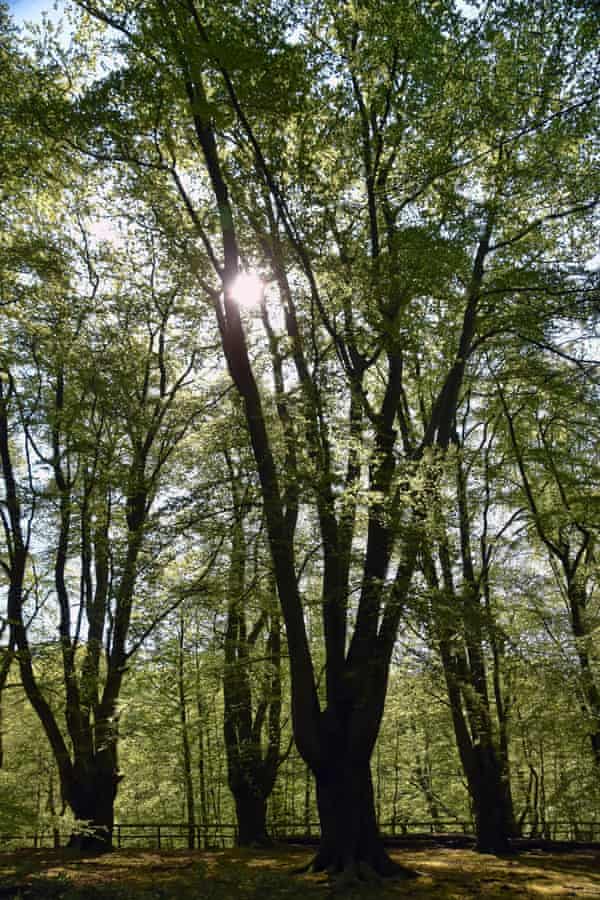
Trees transpire chemical compounds. Nosotros are subconsciously aware of these compounds and nosotros respond with changes in blood pressure. The tree, for its office, is unaware of our response – afterward all, nosotros are not in contact with the tree in any manner. And fifty-fifty if we hug the tree and talk of electric fields, which is ane way we could mutually bear upon each other (considering plants, similar us, function partially by transmitting electrical signals), in that location is nevertheless 1 huge obstruction: fourth dimension. Trees, as we all know, are awfully slow. You lot can multiply the time it takes you to make contact with the tree by 10,000 to detect out when you can look a response.
Copse store memories, respond to attacks and transfer carbohydrate solution, and perchance fifty-fifty memories, to their offspring. All these abilities propose that they must too take a encephalon. Only no 1 has yet plant whatsoever such affair. Professor František Baluška at the University of Bonn has recently been looking into this. For some time now, he has been of the opinion that plants are intelligent – afterward all, they can process data and make decisions – but consciousness takes the discussion to a different level.
Baluška and his colleagues sedated plants that feature moving parts, such as Venus flytraps. The anaesthetics the scientists used deactivated electrical activeness so that the traps no longer reacted when they were touched. Sedated peas showed similar changes in behaviour. Their tendrils, which commonly move in all directions, stopped searching and started to spiral on the spot. Later on the plants broke the narcotics downward, they resumed their normal behaviour.
Did the plants wake up equally we do when we come to afterward a general anaesthetic? This is the critical question, considering in order to wake upward, you demand ane thing in a higher place all others: consciousness. And it was exactly this question that a reporter posed to Baluška. I actually liked his answer: "No one tin can answer this because you cannot inquire [the plants]."
When you hug a tree, cypher electrical happens, considering your voltages are the same. But might the tree be aware of your touch in some other way? All yous accept to do, for instance, is stroke your tomato plants for a few minutes each day and they deadening their upward growth and put their energy into growing thicker stems instead. This, however, is not the plant saying information technology loves you too, but rather the plant reacting to what it probable experiences as a breeze blowing by, because the wind elicits a similar response. If you were hoping to hug a tree and get a hug dorsum, this data must be disappointing.
We do, nonetheless, find a smashing bargain of sensitivity in a completely different office of the tree: its roots. At this level, the tree works its way through the ground with its root tips, which contain brain-like structures. The root tips feel, taste, test and decide where and how far the roots will travel. If there is a rock in the way, the sensitive tips notice and choose a different route. The sensitivity to bear on that tree lovers are seeking is therefore to exist found non in the trunk simply underground. If it is possible to make contact, the roots would be the first place to try. However, they similar neither pressure nor fresh air – and then there'south no point exposing these tender structures, because fifty-fifty 10 minutes in the dominicus spells decease for their tissue.
The nearly contempo scientific discoveries, however, offering something completely unlike: the heartbeat of copse.
What blood is to people, water is to trees. I accept written a lot most how water is transported upwardly into the crown of the tree; exactly how that happens has not withal been adequately explained. Merely Dr András Zlinszky at the Balaton Limnological Found in Tihany, Hungary, is shedding some low-cal on the matter. Some years ago, he and colleagues from Finland and Republic of austria noticed that birch copse appear to rest at nighttime. The scientists used lasers to measure copse on at-home nights. They noticed the branches hung up to 4in (10cm) lower, returning to their normal position when the lord's day rose. The researchers started talking virtually sleep behaviour in trees.
Zlinszky could non get this discovery out of his head, and he decided he needed to investigate further. He and a colleague, Professor Anders Barfod, measured some other 22 copse of unlike species. Once once again, they documented the rise and autumn of the branches, only this time some of the cycles were different. The branches changed position non only morning and night, but also every three to 4 hours. Was information technology believable that the trees were making pumping movements at these regular intervals? Subsequently all, other researchers had already determined that the diameter of a tree's trunk sometimes shrinks by well-nigh 0.002in (0.05mm) before expanding once again. Were the scientists on the trail of a heartbeat that used contractions to pump water gradually upwards? A heartbeat then slow that no one had noticed information technology before? Zlinszky and Barfod suggested this as a plausible caption for their observations, nudging trees 1 step farther toward the animal kingdom.
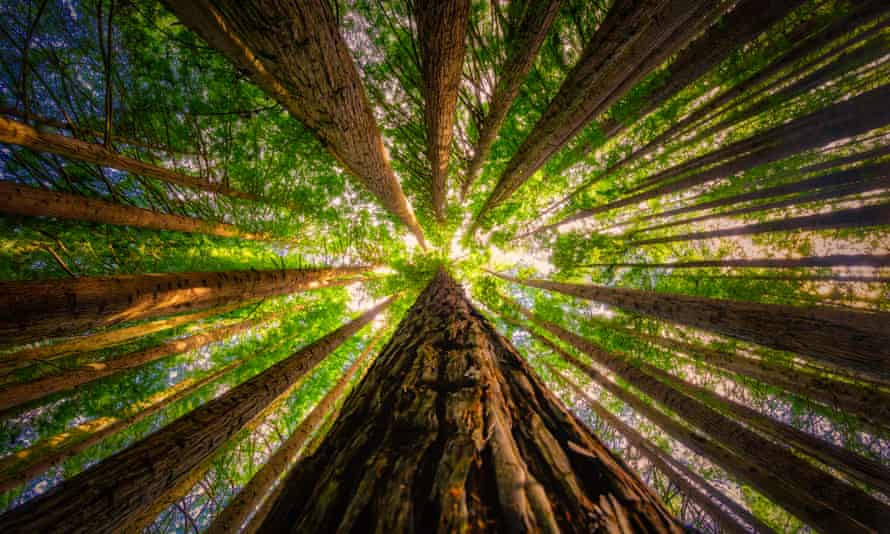
A heartbeat every three to 4 hours is, unfortunately, too slow for even the virtually sensitive person to feel when they hug a tree. But in that location is one last possible way to connect with copse: our voices. Can plants hear? I can answer without hesitation in the affirmative. This was tested years ago with Arabidopsis, a genus of rockcress love of scientists. Beloved considering it grows well, it reproduces chop-chop, and it's like shooting fish in a barrel to proceed track of its genes. Scientists discovered that the roots of Arabidopsis oriented themselves toward clicks in the frequency of 200Hz and then grew in that direction.
Arabidopsis also seems to react to the nibbling of caterpillars, an ominous sound to plants of all species. Researchers at the University of Missouri put caterpillars on samples of the plants. The vibrations caused by the caterpillars munching were enough to shake the plants' stems, and the researchers used laser beams to record the vibrations. When researchers then played these vibrations to plants that were not existence eaten, they produced particularly large quantities of defensive chemicals when they were later attacked. Wind and other sounds with the aforementioned frequency did non elicit a reaction. Arabidopsis, and then, can hear, and this makes perfect sense. Thanks to acoustic warnings, information technology is able to recognise danger some distance away, so it can brand appropriate preparations to defend itself. What is particularly of import here is that the plants ignore noises that pose no threat to them. These noises probably include human voices. What a shame.
I tin can well sympathize people's want to communicate with copse. To sit under these giants, run your hands over their bark, and feel secure – all this would be even more special if there were an active, positive response to your presence or, even meliorate, to your bear upon. I am not going to deny that something like that might be possible, only conservative science at to the lowest degree has no proof that it could happen. And even if this were the last give-and-take on the subject, does the tree have to respond? Could it not be that people and trees live in completely different worlds? Later all, our species has existed for simply 0.1% of the time that trees take been around. For the time existence, it should be enough that we feel skillful effectually trees – and I hope we can and so be content to allow them to live their own wild lives.
Although trees may feel nothing of our attempts to communicate, we, for our part, definitely experience a concrete reaction. I encourage you to experience this for yourself. Make a plan to go outside and immerse yourself in nature. If there is a woods near you, make that your destination. If you live in a metropolis, detect a park or even just a tree-lined street where you can take a walk. Stand up and feel the air on your skin. What tin you odor? The gentle, bawdy aromas of former leaves gently decomposing on the ground or the tangy, brisk scents of new growth? What can you hear? The scratching of squirrels scuttling upward trunks or the rustle of leaves as birds turn them over to find insects underneath? Shut your eyes and feel that this is a place where you belong.
Take a moment to only sit – on a stump or a log or a carpet of leaves. Does that bring you even closer to feeling part of the forest? Run your fingers through the crispness of leaves or over the softness of moss. What do yous know about the trees and plants effectually you? Practise you know their names? Do you know if they are safe to eat and, if they are, how they taste? What more would you similar to learn about their lives, what would you lot hope to detect in guide books and what practise y'all hope scientists will explore in the future so nosotros tin can actually get to know the amazing creatures that are trees in all their biological complexity? We share a world and if they thrive, so exercise we.
Source: https://www.theguardian.com/books/2021/may/28/branching-out-is-communication-possible-between-trees-and-people
0 Response to "How Do You Know When Your Breakthrouh Is Near"
Post a Comment